Journal of Commercializable Technologies (JCT) has its publication subject as Applied Sciences and provides a forum for researchers, innovators, entrepreneurs, industry professionals, and policymakers to disseminate commercially relevant technological advancements. JCT is an international, peer-reviewed scholarly publication dedicated to publishing high-quality original research, innovative technological developments, and translational applications in commercial technology. The journal serves as a dedicated platform for bridging the gap between early-stage technological innovation and successful technology deployment, commercialization, and investment. Published in English and available in an online format, JCT covers multi-disciplinary subjects within Applied Sciences. The journal is published by the SCILEARN TEACH AND NETWORKING FOUNDATION, commenced publication in 2026, and follows a biannual publication frequency, releasing two issues per year at six-month intervals.
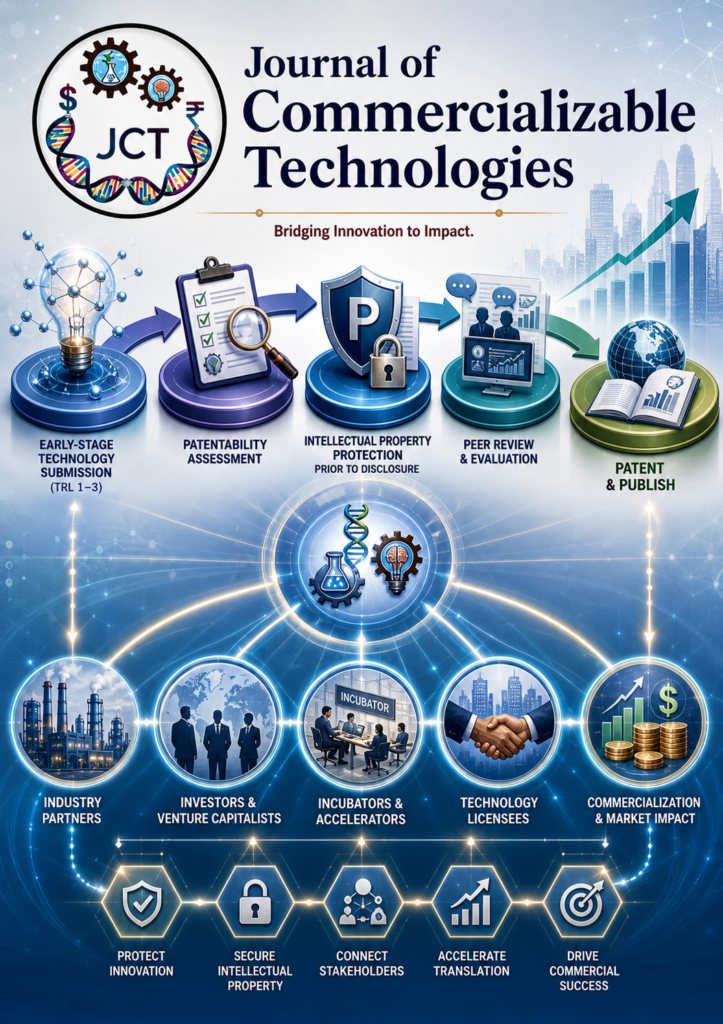
This journal particularly focuses on technologies at Technology Readiness Levels (TRLs) 1–3, where scientific concepts, laboratory-scale innovations, and proof-of-concept developments are often at risk of stagnation due to limited visibility, inadequate intellectual property protection, or insufficient industry linkage
The journal seeks to:
Identify, curate, and disseminate promising nascent technologies with clear commercial or societal application potential.
Facilitate direct visibility and interaction between researchers, innovators, industrial stakeholders, venture capitalists, incubators, and technology investors.
Support authors through structured patentability assessment of submitted work.
Enable intellectual property protection prior to publication, wherein the journal’s IPR team will, where applicable, file patents on behalf of authors before public disclosure.
By integrating technology evaluation, IP protection, and dissemination within a single publication framework, the journal plays a dual role:
(1) safeguarding innovation through early IP intervention, and
(2) accelerating technology translation by making protected innovations accessible to stakeholders capable of advancing them to higher TRLs and eventual commercialization.
Scope of the Journal
Core Scope Areas
The journal covers, but is not limited to, the following technology domains:
- Science and Engineering-Based Technologies
- Biotechnology and life sciences
- Pharmaceutical and biomedical technologies
- Chemical, materials, and nanotechnologies
- Mechanical, electrical, civil, and environmental engineering
- Energy, sustainability, and green technologies
- Food, agriculture, and bio-processing technologies
- Digital and Information Technologies
- Information and communication technologies (ICT)
- Artificial intelligence, machine learning, and data-driven systems
- Automation, sensors, IoT, and smart systems
- Software platforms with clear industrial or commercial application
- Product and Process Innovations
- Novel products, prototypes, or material systems
- Innovative processes, workflows, or manufacturing routes
- Scalable methods that improve efficiency, cost, sustainability, or performance
- Hybrid product–process systems suitable for industrial adoption
- Educational Technologies
- Technology-enabled learning tools and platforms
- Novel pedagogical frameworks with deployable models
- Assessment, evaluation, or delivery systems with commercialization potential
- Digital, AI-assisted, or hardware-supported education solutions
- Social Innovation and Applied Social Sciences
- Technology-driven solutions addressing societal challenges
- Scalable social innovation models with measurable impact
- Novel methodologies applicable to governance, policy, development, or public systems
- Interventions suitable for deployment by institutions, NGOs, or industry
- Physical Sciences and Forensic Technologies
- Applied physics and chemistry-based innovations
- Analytical tools, instruments, and detection systems
- Forensic methodologies, devices, or analytical workflows with field applicability
Thematic Focus
The journal particularly encourages submissions that address:
- Early identification of commercial pathways
- Patentable novelty in products, processes, or methodologies
- Translation of academic research into industry-ready concepts
- Cross-disciplinary technologies that defy traditional journal boundaries
- Innovations at a nascent but high-impact stage
The Journal of Commercializable Technologies is not merely a repository of research articles, but a technology acceleration ecosystem—protecting innovation, showcasing potential, and enabling meaningful engagement between creators and investors at the earliest and most critical stages of technology development.