
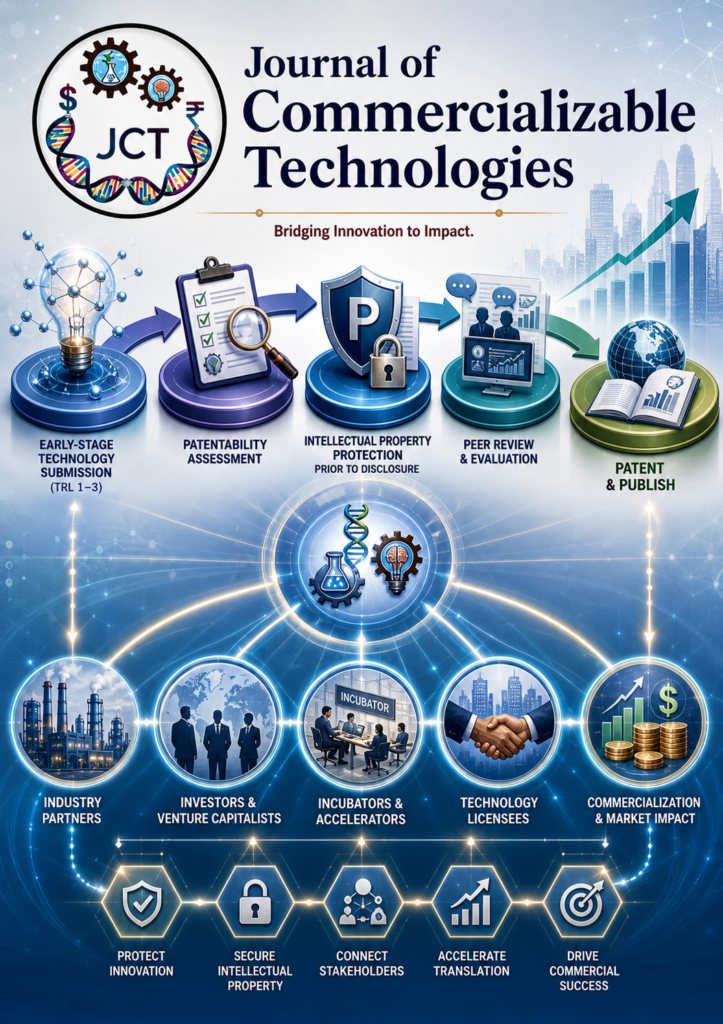
Journal of Commercializable Technologies
The Journal of Commercializable Technologies publishes and protects original research articles, technology reports, and early-stage innovation manuscripts (TRL 1–3) that demonstrate clear potential for commercialization, industrial adoption, or societal impact. Authors benefit from both patent filing and publication. Authors are requested to carefully follow the instructions below to ensure a smooth review and publication process.
Title Page
The title page must include the following information:
Title
- The title should be concise, specific, and informative, clearly reflecting the core technology or innovation presented.
Author Information
Please include:
- Full name(s) of the author(s)
- Institutional affiliation(s): institution, department (if applicable), city, state (if applicable), and country
- Clear indication of the corresponding author, along with an active e-mail address
- The 16-digit ORCID iD of the author(s), if available
If address information is provided with the affiliation(s), it will be published.For authors who are temporarily unaffiliated, only the city and country of residence will be captured. E-mail addresses will not be published unless explicitly requested.
Use of Artificial Intelligence Tools
Authors are advised to use AI tools strictly for improving the presentation of their manuscripts, including grammar, spelling, readability, tone, and formatting of human-generated content. The intellectual content, analysis, and conclusions must remain the sole responsibility of the authors.
Any use of LLMs or AI tools beyond such presentation-related assistance must be explicitly disclosed in the Methods section or an equivalent section of the manuscript.
The use of AI tools solely for AI-assisted copy editing does not require disclosure. However, any generative use of AI involving substantive content creation, data interpretation, or editorial contribution must be clearly disclosed.
In all cases, human authors remain fully responsible for the final content.
Abstract
Authors must provide an abstract of 150–250 words under the following headings:
- Technology Area
- Technology
- Potential Market / Customers
- Technology Valuation (Commercial Potential & Value Proposition)
The abstract should avoid undefined abbreviations and unspecified references.
For life science submissions involving clinical trials (when applicable), include:
- Trial registration number and date for prospectively registered trials
- Trial registration number and date followed by “retrospectively registered” for retrospectively registered trials
Keywords
Please provide 4–6 keywords suitable for indexing and discoverability.
Statements and Declarations
All manuscripts must include a section titled “Statements and Declarations.” Submissions without relevant declarations will be returned as incomplete.
Competing Interests
Authors must disclose any financial or non-financial interests that could influence the work. If no competing interests exist, this should be explicitly stated.
Please revise and customize declaration statements according to your specific circumstances.
Manuscript Text
Text Formatting
- Submit manuscripts in Microsoft Word
- Use a plain font (e.g., 10-point Times New Roman)
- Use italics for emphasis
- Use automatic page numbering
- Do not use field functions
- Use tabs or formatting tools for indents (not spaces)
- Use Word’s table function for tables
- Use Equation Editor or MathType for equations
- Save files as .docx (Word 2007 or later) or .doc
Manuscripts containing extensive mathematical content may also be submitted in LaTeX (Springer Nature LaTeX template recommended).
Headings
- Use no more than three levels of displayed headings.
Abbreviations
- Define abbreviations at first mention and use them consistently thereafter.
Footnotes
- Use footnotes sparingly for additional information
- Do not use footnotes solely for references
- Do not include figures or tables in footnotes
- Number text footnotes consecutively
- Use lowercase superscripts for table footnotes
- Always use footnotes, not endnotes
Acknowledgments
Acknowledgments of individuals, grants, or funding sources should appear in a separate section on the title page. Funding agency names must be written in full.
References and Citations
Authors are responsible for ensuring the accuracy, completeness, and consistency of all references cited in their manuscripts. The Journal of Commercializable Technologies (JCT) follows an author–year citation system and recommends adherence to the APA 7th Edition guidelines for both in-text citations and reference list preparation.
In-text Citations
References should be cited in the text using the author–year format.
Examples
- Single author: (Thompson, 1990)
- Two authors: (Becker & Seligman, 1996) or Becker and Seligman (1996)
- Three or more authors: (Abbott et al., 1991)
- Multiple references: (Abbott et al., 1991; Barakat et al., 1995)
- Narrative citation: Thompson (1990) demonstrated that…
All sources cited in the text must appear in the reference list, and all references listed must be cited in the manuscript.
Reference List
The reference list should appear at the end of the manuscript under the heading References. Entries should be arranged alphabetically by the surname of the first author and formatted according to APA 7th Edition style.
Journal Article
Format
Author, A. A., Author, B. B., & Author, C. C. (Year). Title of the article. Journal Name, Volume(Issue), page range. DOI/URL
Example
Kapoor, R., Sharma, S., & Kumar, A. (2024). Optimization of cellulase production from lignocellulosic biomass using fungal strains. Journal of Biotechnology Research, 18(2), 115–126. https://doi.org/10.1234/jbr.2024.018
Book
Format
Author, A. A. (Year). Title of book (Edition, if applicable). Publisher.
Example
Singh, P., & Verma, R. (2023). Bioprocess engineering fundamentals (2nd ed.). Academic Press India.
Book Chapter
Format
Author, A. A. (Year). Title of chapter. In E. E. Editor & F. F. Editor (Eds.), Title of book (pp. xx–xx). Publisher.
Example
Kumar, S., & Gupta, N. (2025). Enzyme-assisted biomass conversion technologies. In R. Kapoor & P. Sharma (Eds.), Advances in bioethanol production (pp. 75–98). Springer Nature.
Conference Paper
Format
Author, A. A., & Author, B. B. (Year). Title of paper. In Proceedings Title (pp. xx–xx). Publisher. DOI/URL (if available)
Example
Mehta, V., & Arora, D. (2024). Artificial intelligence for process optimization in biotechnology. In Proceedings of the International Conference on Emerging Technologies (pp. 120–126). IEEE.
Patent
Format
Inventor, A. A. (Year). Title of invention (Patent No. XXXXXXX). Patent Office/Country.
Example
Kapoor, R., Kumar, S., & Sharma, A. (2025). AI-based culture medium optimization system for medicinal plants (Indian Patent No. IN202511012345). Indian Patent Office.
Thesis or Dissertation
Format
Author, A. A. (Year). Title of thesis/dissertation [Master’s thesis or Doctoral dissertation, Institution Name].
Example
Sharma, P. (2024). Production of bioethanol from agricultural residues using microbial consortia [Doctoral dissertation, Maharshi Dayanand University].
Web Page or Online Resource
Format
Author/Organization. (Year, Month Day). Title of webpage. Website Name. URL
Example
World Intellectual Property Organization. (2025). Global Innovation Index 2025. https://www.wipo.int/global_innovation_index
Report
Format
Author/Organization. (Year). Title of report. Publisher. URL (if available)
Example
Organisation for Economic Co-operation and Development. (2024). Science, technology and innovation outlook 2024. OECD Publishing. https://www.oecd.org
DOI and URL Requirements
- Authors should provide a DOI (Digital Object Identifier) whenever available.
- URLs should be included for online-only resources.
- Hyperlinks should be active and accessible at the time of submission.
Reference Management Software
Authors may use reference management software such as EndNote, Mendeley, Zotero, RefWorks, or similar tools. Manuscripts should be carefully checked to ensure consistency between in-text citations and the reference list prior to submission.
Tables
- Number tables consecutively using Arabic numerals
- Cite tables in text in numerical order
- Provide a clear caption for each table
- Acknowledge previously published material
- Use superscripts for footnotes below the table body
Figures and Illustrations
Electronic Submission
- Submit all figures electronically
- Preferred formats: EPS (vector), TIFF (halftones); MS Office files acceptable
- Embed fonts in vector graphics
- Name files as Fig1.eps, Fig2.tiff, etc.
Resolution Requirements
- Line art: minimum 1200 dpi
- Halftone images: minimum 300 dpi
- Combination artwork: minimum 600 dpi
Color Figures
- Free for online publication
- Ensure clarity if converted to black-and-white for print
- Submit color images in RGB format
Figure Captions
- Include captions in the manuscript text file
- Begin with Fig. in bold, followed by the figure number in bold
- No punctuation at the end of captions
- Identify all elements in the figure
Permissions and Accessibility
Authors must obtain permission for previously published material.
To ensure accessibility:
- Provide descriptive captions
- Use patterns in addition to color
- Ensure sufficient contrast (minimum 4.5:1)
Generative AI Images
Any AI-generated visual content must adhere to ethical and disclosure standards.